


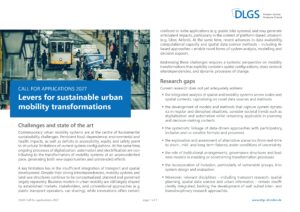
Levers for sustainable urban mobility transformations
Challenges and state of the art
Contemporary urban mobility systems are at the centre of fundamental sustainability challenges. Persistent fossil dependence, environmental and health impacts, as well as deficits in accessibility, equity and safety point to structural limitations of current system configurations. At the same time, ongoing processes of digitalization, automation and electrification are contributing to the transformation of mobility systems at an unprecedented pace, generating both new opportunities and unintended effects.
A key limitation lies in the insufficient integration of transport and spatial development. Despite their strong interdependencies, mobility systems and land-use structures continue to be conceptualized, planned and governed largely separately. Business models in urban mobility are still largely shaped by established markets, stakeholders, and conventional approaches (e.g. public transport operators, car-sharing), while innovations often remain confined to niche applications (e.g. public bike systems) and may generate ambivalent impacts, particularly in the context of platform-based urbanism (e.g. Uber, Airbnb). At the same time, recent advances in data availability, computational capacity and spatial data science methods—including AI-based approaches—enable novel forms of system analysis, modelling and decision support.
Addressing these challenges requires a systemic perspective on mobility transformations that explicitly considers spatial configurations, cross-sectoral interdependencies, and dynamic processes of change.
Research gaps
Current research does not yet adequately address:
- the integrated analysis of spatial and mobility systems across scales and spatial contexts, capitalizing on novel data sources and methods
- the development of models and methods that capture system dynamics in regular and disrupted situations, consider societal trends such as digitalization and automation while remaining applicable in planning and decision-making contexts
- the systematic linkage of data-driven approaches with participatory, inclusive and co-creative formats and processes
- the exploration and assessment of alternative scenarios (from real-time to short-, mid- and long-term futures) under conditions of uncertainty
- the role of institutional arrangements, governance structures and business models in enabling or constraining transformation processes
- the incorporation of inclusion, particularly of vulnerable groups, into system design and evaluation
Moreover, relevant disciplines—including transport research, spatial planning, spatial data science and urban informatics—remain insufficiently integrated, limiting the development of well suited inter- and transdisciplinary research approaches.
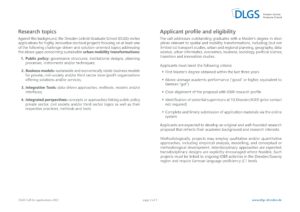
Research topics
Against this background, the Dresden Leibniz Graduate School (DLGS) invites applications for highly innovative doctoral projects focusing on at least one of the following challenge-driven and solution-oriented topics addressing the above gaps concerning sustainable urban mobility transformations:
- Public policy: governance structures, institutional designs, planning processes, instruments and/or techniques;
- Business models: sustainable and economically viable business models for private, civil-society and/or third sector (non-)profit organisations offering solutions and/or services;
- Integrative Tools: data-driven approaches, methods, models and/or interfaces;
- Integrated perspectives: concepts or approaches linking public policy, private sector, civil society and/or third sector logics as well as their respective practices, methods and tools.
Applicant profile and eligibility
The call addresses outstanding graduates with a Master’s degree in disciplines relevant to spatial and mobility transformations, including (but not limited to) transport studies, urban and regional planning, geography, data science, urban informatics, economics, business, sociology, political science, transition and innovation studies.
Applicants must meet the following eligibility criteria:
- First Master’s degree obtained within the last three years
- Above-average academic performance (“good” or higher, equivalent to German “gut”)
- Clear alignment of the proposal with IOER research profile
- Identification of potential supervisors at TU Dresden/IOER (prior contact not required)
- Complete and timely submission of application materials via the online system
Applicants are expected to develop an original and well-founded research proposal that reflects their academic background and research interests.
Methodologically, projects may employ qualitative and/or quantitative approaches, including empirical analysis, modelling, and conceptual or methodological development. Interdisciplinary approaches are expected; transdisciplinary designs are explicitly encouraged where feasible. Such projects must be linked to ongoing IOER activities in the Dresden/Saxony region and require German language proficiency (C1 level).
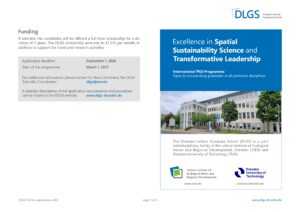
Funding
If selected, the candidates will be offered a full-time scholarship for a duration of 3 years. The DLGS scholarship amounts to €1,515 per month, in addition to support for travel and research activities.
Please note: Our eligibility criteria are fixed, including the requirement that applicants must have obtained their first Master’s degree within the last three years. All materials must be submitted through our online application form. We do not accept applications via email or post. Incomplete applications will not be considered.
Application deadline
September 1, 2026
Programme Start
March 1, 2027
Need help in landing a scholarship? Our comprehensive scholarship assistance includes appraising eligibility criteria to guide applicants correctly and help them avail of scholarships offered by colleges, universities, and government bodies occasionally. Get in touch with our experts and scholarship beneficiaries for insights.
Fill out the form below;
Reach out via phone on;
(+237) 676417518 or 658214537
Check our scholarship finder for more scholarships
Do you want to stay current with the job market by being informed about the latest job opportunities? Use this link to join our WhatsApp job group;