



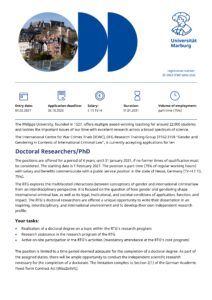
The Philipps University, founded in 1527, offers multiple award-winning teaching for around 22,000 students and tackles the important issues of our time with excellent research across a broad spectrum of science.
The International Centre for War Crimes Trials (ICWC), DFG Research Training Group (RTG) 3159 “Gender and Gendering in Contexts of International Criminal Law”, is currently accepting applications for ten
Doctoral Researchers/PhD
The positions are offered for a period of 4 years, until 31 January 2031, if no former times of qualification must be considered. The starting date is 1 February 2027. The position is part-time (75% of regular working hours) with salary and benefits commensurate with a public service position in the state of Hesse, Germany (TV-H E 13, 75%).
The RTG explores the multifaceted interactions between conceptions of gender and international criminal law from an interdisciplinary perspective. It is focused on the question of how gender and gendering shape international criminal law, as well as its legal, institutional, and societal conditions of application, function, and impact. The RTG’s doctoral researchers are offered a unique opportunity to write their dissertation in an inspiring, interdisciplinary, and international environment and to develop their own independent research profile.
Your tasks:
-
Realization of a doctoral degree on a topic within the RTG’s research program
-
Research assistance in the research program of the RTG
-
Active on-site participation in the RTG’s activities (mandatory attendance at the RTG’s core program)
The position is limited to a time period deemed adequate for the completion of a doctoral degree. As part of the assigned duties, there will be ample opportunity to conduct the independent scientific research necessary for the completion of a doctorate. The limitation complies to Section 2(1) of the German Academic Fixed-Term Contract Act (WissZeitVG).
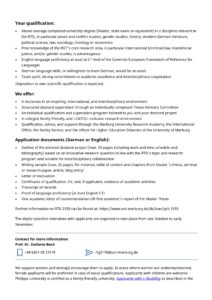
Your qualification:
-
Above-average completed university degree (Master, state exam or equivalent) in a discipline relevant to the RTG, in particular peace and conflict studies, gender studies, history, modern German literature, political science, law, sociology, theology or economics
-
Prior knowledge of the RTG’s core research area, in particular international (criminal) law, transitional justice, and/or gender studies, is advantageous
-
English language proficiency at least at C1 level of the Common European Framework of Reference for Languages
-
German language skills, or willingness to learn German, would be an asset
-
Team spirit, strong commitment to academic excellence and interdisciplinary cooperation
-
Disposition to own scientific qualification is expected
We offer:
-
A doctorate in an inspiring, international, and interdisciplinary environment
-
Structured doctoral supervision through an individually composed Thesis Advisory Committee
-
An individual qualification and supervision program tailored to you and your doctoral project
-
A collegial, family-friendly, and LGBTIQ+-inclusive research environment
-
Qualification, advice, and support through the Marburg University Research Academy, the International Office, the Family Service, and the offices for Higher Education Didactics of the University of Marburg
Application documents (German or English):
-
Outline of the planned doctoral project (max. 10 pages including work and schedule and bibliography) based on an innovative research question in line with the RTG’s topic and research program and suitable for interdisciplinary collaboration
-
Writing sample (max. 25 pages, for instance, table of contents and chapters from Master’s thesis, seminar or research paper, article, blog entry)
-
Letter of motivation
-
Certificates of qualification, CV, and, if applicable, evidence of academic activities
-
Transcript of records
-
Proof of language proficiency (at least English C1)
-
One academic letter of recommendation OR first examiner’s report of the Master’s thesis
Further information on RTG 3159 can be found at: [website not visible in document]
The digital selection interviews with applicants are expected to take place from late October to early November 2026.
Contact for more information
Prof. Dr. Stefanie Bock +49 6421-2823119 rtg3159@uni-marburg.de
We support women and strongly encourage them to apply. In areas where women are underrepresented, female applicants will be preferred in case of equal qualifications. Applicants with children are welcome – Philipps-University is certified as a family-friendly university. Applicants with a disability as described in the Social Security Code (Section 2(2) and (3) of Book IX of the Social Security Code (SGB IX)) will be preferred in case of equal qualifications.
Please apply by 4 October 2026 using the application button below
The document lists the salary as TV-H E 13 at 75% part-time. It does not give an exact monthly figure, but here is what that means in practice:
Approximate monthly gross salary: €3,400 – €3,700 per month
(This is before taxes and social insurance deductions.)
How this breaks down:
-
TV-H E 13 is the standard German public-sector pay grade for doctoral researchers.
-
The exact amount depends on your experience level (Stufe) within the E 13 scale.
-
Stufe 1 (no prior experience): roughly €3,400–€3,500 gross at 75%
-
Higher Stufen (with prior relevant experience): up to roughly €3,700+ gross at 75%
-
-
75% means you work 30 hours per week (based on a 40-hour full-time week).
Apply Here
Full Announcement Here in PDF
Need help in landing a scholarship? Our comprehensive scholarship assistance includes appraising eligibility criteria to guide applicants correctly and help them avail of scholarships offered by colleges, universities, and government bodies occasionally. Get in touch with our experts and scholarship beneficiaries for insights.
Fill out the form below;
Reach out via phone at;
(+237) 676417518 or 658214537
Check our scholarship finder for more scholarships
Do you want to stay current with the job market by being informed about the latest job opportunities? Use this link to join our WhatsApp job group;